
 I was a stone geek most of my life, I admit it. In fact, I still am in many ways, although I’ve changed a lot in recent years. By geek I mean I was this annoying smart boy who knew everything about facts and logic but knew nothing about life or emotions. Then, a few years ago, I had some catastrophic life events that turned my life upside down, and I spent my last few years to rebuild my life from the ground. I had to work for years until I could get an understanding of emotions, traumas, psychology, and therapy, what they mean, how they relate, what are their roles, and how they help. I did an awful lot of work until I could understand and see what I see now, and I hope that summarizing my experience and knowledge in this piece of writing will help me deepen my understanding further.
Moreover, I get furious sometimes that nobody taught me about all this earlier. It could have saved me a lot of trouble and suffering. Okay, probably I wasn’t very receptive to anything outside pure rationality, but come on, they could have tried a little harder! This is no rocket science, and no magical hocus-pocus either. This can be told within the bounds of pure logic, even to an emotional analphabet! This writing is my best try to correct this mistake and fill the gap. Consider it my letter to my 10, 15, 20 or 30 years old geeky self, to make his life a little less miserable. The “geeky” part is essential because I swear to you that you can chop my fingers off if you catch me using any vague, mysterious or cheesy concept and expression.
I have one more motivation as well. Since emotions and psychology were the top priority and the most important endeavor of my life in the last five years, I talked about it a lot to my family, to friends, and to many more. And boy, I’ve seen lots of staring faces, thinking something like “Jesus, what the hell is going on with this guy?” or “If he thinks this helps him, he should just do it, but maybe he shouldn’t talk about it.” There are a few people who were really interested and persistent, to whom I could really talk a lot about all this, and it made some sense to them. But telling the essence in ten minutes or half an hour? I found it impossible. I’d be better off if I didn’t even start. So this writing is for you, my friend, as well. If you want to know what happened to me in the last several years, here is my shortest possible answer, told in a way that (hopefully) won’t freak you out.
Before you start, I want to warn you, this is going to be a long read! This is the result of working five years on myself, reading about a hundred books, doing five years of individual therapy with two different therapists, group therapies, meditation, and countless other workshops. But if you consider I’ve done this much to reach this point, then this is a very short and concise summary.
I structured this article into three major parts. The first part is the “starting from the distance,” an analysis of the factors and root causes in humans that make emotional issues possible in the first place. The second part discusses the problem itself: the basics and role of emotions, how they affect us, why are they essential, and finally, how and why they get us into possibly life-long trouble. In the third and final part, I talk about the solution: how can we find our way out of the mess our emotions have led us, why is this so damn difficult, why is it so easy to get lost, and how can we make sure we go to the right direction. I highlight most of my real-life examples with italic fonts to separate it from everything else.
So if you’re ready, take a deep breath, and let’s start.
Part I: Root Causes of the Problem
To understand emotions and emotional problems, we have to examine and understand the characteristics of the human species and the human brain first.
Let me explain what emotions are and why they are essential for us humans, discovering and emphasizing the key factors that make emotions essential for our lives. These factors are simple, concrete facts about evolution, the human body or the human brain. Some of these are independent of each other, others relate in some ways, but each one contributes to the big picture in some essential way.
I try to paint these facts with scientific rigor, then I ponder a little why it is the way it is, why evolution took the course it eventually did. This is something we can’t ever be sure about, so strictly scientific approach is impossible here, I still find it useful to wonder about the reasons why evolution did something we see or experience today.
At the end of each point, I take a short detour and invite you to imagine a world or a different course of human evolution where these phenomena would be different. I find this interesting (remember, I am a geek!) so I will play a bit, just to understand the role of these factors a little better and deeper.
1) The Complexity of the Fundamental Human Needs
Every living being has some basic needs to live their lives and function, for example, appropriate temperature, sunshine, water or food. When these needs are not met, the creature gets sick or dies. Nature designed organisms to find ways to fulfill their needs. These fundamental needs vary by species. Some organisms have very simple needs, some have more complex, but all need to find their ways to satisfy them (or most of them) to survive, function, and stay healthy.
Many animal species can spend most of their lives alone and are perfectly able to satisfy all their needs by themselves, and live a healthy and full life without the need for their mates’ company. Unlike such animals, we humans are pack animals. This means that we are not able to fulfill all our fundamental needs by ourselves. We are not strong enough, we can’t run fast enough, our skin and hair are not thick enough to secure an easy life out there alone in the wilderness.
Our distinctive feature is our highly developed brain, capable of abstract thinking, modeling, planning, deception, and cooperation, making us able to accomplish extraordinary feats when forming groups, teams, and societies. This extraordinary brain and cooperation skills of ours come with a price. Our fundamental needs for survival and staying healthy are much broader and more complex than of any other species. Our well-being is greatly defined by how we relate to other humans.
The most well-known system of this is Maslow’s hierarchy of needs.
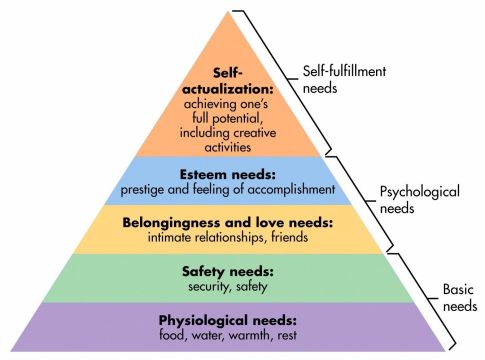
You can see how many different things we have to take care of to thrive as a human being. Besides, as we climb this pyramid to the top, the needs are becoming more and more complex, complicated and impossible to fulfill on our own. While we can take care of our physiological and safety needs, and maybe part of our self-fulfillment needs, most of our psychological and self-actualization needs are fully dependent on our mates and our social environment.
What is the bottom line? Unlike many other species, we have very complex psychological and self-actualization needs besides our basic physiological needs.
Why is this useful? At first, it seems like this only brings a lot of difficulty and trouble in our life. Just think about how much easier and simpler our lives might be without all these complex psychological and self-fulfillment needs. But there must be some reason why we still have them. Actually, we can also be very grateful for this course of evolution because these needs make us cooperate and collaborate with each other in remarkable ways. This is the key to rule every other species against the odds of our physical weakness and to accomplish incredible achievements like families, society, culture, economy, technology, education and many more wonders we have created through history.
What are the side-effects? Our health and well-being, the fulfillment of our needs are highly dependent on other people and our social environment. We can get emotionally and physically sick when our needs are not met.
What if it wouldn’t be this way? Let’s just imagine a world where our human needs would stop at the second level of Maslow’s pyramid. Imagine if we wouldn’t care much about others (besides killing to eat and mating to reproduce), and our well-being would be based on just food, shelter, and security. Well, this is not so difficult to imagine, many other species live this way: tigers, black rhinos, and even those lovely giant pandas. If the sun shines enough, there is enough bamboo or meat to eat, they have the perfect day and couldn’t care less about anything else. In this case, we wouldn’t see all the wonders of humankind around as, but we wouldn’t have all these fucked up emotional problems either. Our life would be simple, and I wouldn’t have to write about all these crappy psychological bullshit right now.
2) The Long Helplessness of Human Babies
Different animals have wide variability in how self-sufficient they come into this world. Many can fend for themselves without parental help almost immediately. Newborn giraffe calves are able to clamber upright and walk on their own within hours of birth. Human babies, however, are a different story. In the first two months, they can’t even lift their heads up without help. They roll over for the first time at about 4 months and sit up at around 6 months. They usually start standing at about 9 months and take their first tentative steps at around the age of 1 year. But even then, babies are just getting started. Fine-tuning the most basic survival skills, such as walking and feeding themselves, takes at least another year or more, and they generally remain dependent on their caregivers for well over a decade before they’re even able to begin to navigate through parts of the world on their own.
When animals produce self-sufficient babies, it’s for several reasons related to both biology and behavior. Some animals need their infants to be mobile as quickly as possible – in water or on land – because adults are constantly on the move and the youngsters need to keep up (or keep away from predators). Other species that don’t roam as widely hunker down with helpless babies in their nests or burrows. There is some variability in mammals. Although all mammal newborns are dependent on their mothers for nutrition, some are more physically capable as newborns than others.
Some theories claim that human babies are born so underdeveloped and helpless because of their large brain and the relatively narrow hips of their mothers. Unlike other mammals, humans walk upright, which is very difficult – if possible – with significantly wider hips. This was the tradeoff that evolution made: large skull, narrow hips, early birth.
What is the bottom line? Compared to other species, human babies remain dependent on their caregivers for a much more extended period of their lives. They need more than a decade to be able to live and take care of themselves on their own.
Why is this useful? This longer maturation rate allows us to develop much more sophisticated thinking than other species. The extra time that humans need to acquire certain abilities is part of the evolutionary trade-off for having highly developed brains capable of managing complex reasoning, communication, and social interaction, alongside the physical requirements and capabilities of our adult bodies.
What are the side-effects? Our emotional foundations and world-views are determined by our parents’ or caregivers’ availability, personality, emotional maturity, and belief-system, much more than by our DNA.
What if not? Let’s imagine a world where we can take care of ourselves from a much younger age. In this case, our parents’ and their attributes wouldn’t have such a significant impact on our lives because we’d learn about life and the world from a wider social environment, which is more balanced than the nature of a few individual people’s. This would result in less variation in individual belief-systems, world-views, and emotional stability.
3) Evolution and the Structure of the Human Brain
When we talk about our brain, we think about our rational, logical, thinking brain. But actually, your brain has three fundamentally different parts, like three different layers built on top of each other, with different functions and roles. This is what we call the three brain theory or the triune brain. These brain parts are:
- Reptilian brain: responsible for our lower level fundamental, physical functioning like pain or breathing
- Emotional brain (paleomammalian complex or limbic system): responsible for our emotions like anger, fear, sadness, joy or shame
- Thinking brain (neomammalian complex or neocortex): responsible for rational, logical, abstract thinking, self-reflection, modeling, foresight, planning, and other high-level cognitive thinking, that separates us from every other species on Earth
These three brain parts developed in this order during evolution. The reptilian (as the name suggest) brain developed earlier in phylogenesis. Simpler species (like insects or reptiles) have developed this kind of brain, but a tiny emotional brain and no thinking brain whatsoever. The emotional brain developed later, in more complex and developed species, very few species have developed thinking brains, and there are no other species that have a thinking brain come anywhere near the abilities of our human thinking brain.
For species like us, who possess all three brains, the development and relationship between these are hierarchical. The different parts develop in different stages of life:
- The reptilian brain develops at the earliest age. For example, a newborn baby is fully capable of breathing
- The emotional brain develops from the earliest age until the age of around six or seven years
- The thinking brain develops at the latest stage. Infants have very little or no capacity for logical and abstract thinking. Their rationality starts developing later, around the age of five or six
The relationship and hierarchy between these brain parts are simple: the earlier the brain part, the more priority and authority it has over our actions, and over the other parts of your brain. That means, you can decide that you stop breathing (thinking brain), but you will fail at actually stopping it (reptilian brain). You just can’t stop breathing. It is not working. Your reptilian brain will override the decision of your thinking brain. Similarly, it is extremely c to ignore or override your emotions with pure rational thinking and conscious decision, especially in emotionally intensive situations.
Let me take a detour to explain emotions a little. Emotions are our bodies’ and brains’ built-in functions to make us act as a response to something that is happening to us. Emotions show you that something is going on, and they make you do something about it. They are short circuits that give you energy for instant action, without hesitation, without rational thinking. They are similar to reflexes, which make you do things automatically and unconsciously. I repeat this because it is essential: just like reflexes, emotions are not a choice, they are automatic! That means you have no direct control over them. The very role of emotions is to shut down rational thinking and make you act immediately because your life can depend on it. You have (some) control over your actual actions, but no direct control over your underlying emotions. You can choose not to punch someone in the face, but you can’t choose not to be angry at him!
Emotions are essential and extremely useful features of our bodies, with particular roles and functions:
- Fear makes you flee when you perceive danger
- Anger makes you fight when you need to defend yourself or your family
- Shame makes you know you have limits when you cross certain norms and boundaries
- Sadness makes you grieve and heal when you experience loss
- Joy makes you celebrate when you are happy or proud
Therefore, emotions are primal. You can lie to yourself, you can convince yourself you are not angry or sad, you can make up stories and rationalizations, or you can suppress your emotions altogether, but you can’t make them go away. As we will see, you can deal with your emotions and influence them in different indirect ways, but never by sheer force, willpower or conscious decision. Just like you can’t stop breathing, whether you want it or not, whether you think about it or not. Emotions govern your actions and decisions in minor or major ways, whether you like it or not. Some people are governed by them more, some people less. Some people can see and admit this, some deny, but we are all deeply affected by our emotions. Emotions are designed by evolution to matter and to govern us.
What is the bottom line? Our brain is structured in different layers, in a determined hierarchy. Your emotional and rational brain has very distinct functions and roles. Emotions are like interruptions in the thinking process, for intensive emergency situations, to take control and make you take action to protect yourself. Emotions are designed to pressure you for instant decisions and actions, by overruling rational thoughts.
Why is this useful? If you think about it, this structuring and development of our brain make us extraordinarily robust and resilient. Our basic physical functioning is automatic, like a process running invisibly in the background, we can’t shut them down or change them voluntarily. Then we have these special interruptions called emotions for high-intensity emergency situations, that can take over control immediately and make us act to save our asses. Then, when everything works just fine and we are in a time of peace, we have the thinking brain, capable of amazing high-level, abstract thinking, like modeling, reflecting, planning, imagining. Pretty impressive design, built by evolution, isn’t it? Even an engineer or software architect can lick his fingers, seeing this system.
What are the side-effects? The side-effects are direct consequences of the very design of emotions. They are automatic shortcuts for ruling our lives and are extremely difficult to override their commands. Most of the time, emotions are functional, that means they support us and help us to stay safe, healthy, and happy. But sometimes, they are not. Sometimes our anger makes us punch people in the face. Sometimes fear makes us avoid things that otherwise would be beneficial for us. Sometimes shame prevents us from showing ourselves and receiving the connection and understanding we crave for so much. And when this happens, very often no amount of thinking, planning, or rational decision-making can help us to change our behavior, because emotions are designed to be stronger than thoughts.
What if not? It is not hard to imagine how much more fragile and less capable we would be if we change any of these brain parts or their working relationships. If we can forget to breathe, or if we start thinking and planning about what to do when a lion attacks us, well, we wouldn’t have a very long life. On the other hand, if we had no emotions, or we couldn’t come up with rationalizations and made-up stories about them (thank to our thinking brain), then we wouldn’t be able to put ourselves into various emotional pitfalls, but let’s talk about this a little later.
4) The Development of a Child’s Brain
So we have seen that the different parts of your human brain develop in different stages. Let’s skip the boring reptilian brain part, and take a closer look at how the emotional and thinking brain develops. The thinking brain is only developing in later stages, this is why a little child – until about the age of five or six – is living in a non-logical, kind-of-magical world. Without a developed thinking brain, a child is not yet able of strict rational and logical thinking, reasoning, creating abstractions, self-reflection, foresight, planning, or understanding the concept of time.
This inability makes them so cute and adorable because they see the world through entirely different lenses and logic, through the logic of emotions. This crucial period, until the age of about six years, is the intense formulation, development, and consolidation of the emotional brain. As we have seen, this brain works in fundamentally different ways than the thinking brain. Children are naturally living in the present and are in an intimate relationship with their emotions.
As they meet their close and ever-widening environment, they learn through experiences emotionally, without language, abstract thoughts or concepts. Everything they experience is ingrained in them deeply, through emotions. What they learn in this first few years are the fundamental views about the world, family, people, themselves, and their role in the world. Every child develops a complex belief-system, through answers to such crucial questions as:
- Is the world friendly and safe?
- Am I welcome in the world?
- Am I worthy and lovable?
- Am I taken care of?
- Can I ask and expect help?
- Are my needs okay?
- Can I trust the world and people?
- Can I trust myself? Am I capable of accomplishing things?
- Can I try? Is it okay to make mistakes?
- Do I deserve respect?
- Do I have rights? What are they?
- What are my duties?
- Can I count on others?
- Is cooperation possible?
- Is what I own really mine? Or is it taken away anytime?
- Is love permanent, conditional or unpredictable?
- Am I allowed to be fearful or sad?
- Am I allowed to be happy or angry?
- What do I do when I don’t agree with something?
- Do I have to be ashamed? When?
- How should I handle conflicts?
- Are changes good or bad?
Children learn all these things through experience and example:
- The experience of how their parents and other people treat them and relate to them
- The example of how their parents and other people relate to others and act in the world
In the early years, the emotional brain shows incredible flexibility and adaptivity, building the emotional foundations of the child with astonishing speed and with deep emotional “wiring.” This adaptive learning process then starts to slow down, until about the age of six, when the worldview and psychological functioning of the child solidifies and gets more rigid. This emotional wiring is very hard to override or change after that point. That means that the collected experiences of these early years (0-6 years of age) will determine almost entirely the emotional functioning and the belief-system of the child in his later life. The older we are, the less capable an event or experience can change our view of the world and our emotional functioning. Anything unusual is more like an exception of the already learned rule.
What is the bottom line? Children have an incredibly adaptivity and capacity to learn about the world and themselves in their early years. However, until the age of about six, their rational thinking brain is not yet developed, so they learn everything through experience and example, with their emotional brain, forming a deeply ingrained belief-system and emotional functioning for about the age of six, where this process slows down, and the development of the thinking brain takes part.
Why is this useful? First of all, children’s incredible ability to learn and adapt are extremely useful and essential features of the human brain. It makes adaptation possible for a child, regardless of the parents, community, society, environment, or world. This feature is also very “costly,” probably evolution “designed” humans to change this unbelievable adaptivity in later years to rigidity and productivity. Also, in societies thousands of years ago, adaptivity after early childhood would probably have been a useless feature, since fundamental changes in the world and circumstances during a human’s lifetime were very rare (unlike in our ever-accelerating world today).
What are the side-effects? The major side-effect of this adaptive emotional learning process and its slowing down is that early experiences and their resulting beliefs and emotional reaction schemes are extremely hard to change later on, because it is deeply imprinted, on an emotional level (which is extremely difficult to override by rational thinking), and the learning process becomes slow and rigid. As you will see, this is a critical element in the formation of emotional problems later in life.
What if not? It is interesting to imagine a world and its consequences with a different early learning process:
- What if we learn only on a rational level? The upside is that therapy would be easier or nonexistent, only on a rational level. The downside is that we would find little use of that learning without the power of emotional support.
- What if our brain would not be so adaptive and flexible in childhood (for example or DNA-inherited learning)? The upside is that our parents and our childhood experiences won’t matter that much in determining our personality and belief-system. The downside is that it would be impossible for us to adapt to the ever-changing world and circumstances from generation to generation.
- What if our brain would stay adaptive and flexible also after childhood? The upside is an easier solution to emotional problems, easier work for therapists. The downside is that such level of brain activity can probably be held only at the expense of other things, like productivity or parenting.
5) The Triggering Mechanism of Emotions
Now that we’ve seen how the child learns essential things about the world on an emotional level, let’s see how this knowledge gets activated later in life because this is where the problems are arising. The mechanism is straightforward:
- The child experiences something important in a situation in her early life
- She gives an intense emotional reaction to the experience
- This emotion makes her react in a way that the emotion dictates
- The memory and the related emotion gets imprinted deeply in her emotional brain
- Later in life, she experiences an intense situation that reminds her of the circumstances of her early experience
- Her emotional brain takes over control, evokes the early experience, along with the same emotional reaction and the same automatic action that is imprinted
The emotional brain part is important because both the learning, both the experience activation takes place here, resulting in an immediate, automatic, often unconscious reaction in certain situations, leaving little or no place for the thinking brain to intervene in the process. Let’s see this through a simple example.
Jane is a sweet little baby. When she left the paradise of her mother’s belly, she was a bit shocked and scared because of the enormous change in the world around her. She didn’t like the cold, the harsh voices, the sharp lights, the strange smells, but after a few seconds, she found herself in the comforting, warm hands of her mother, with her already-familiar scent. Her mother was holding her, caressing her, comforting her with all her heart, and soon Jane felt safety again in this brand new and very different world. Her early anxiety soon turned into a feeling of safety and comfort. As a result, later in life, whenever she finds herself in a new, stranger environment (new job, new city, new country, new culture, a hospital), her early experience of a new world gets evoked. She feels some anxiety, but her excitement is always more dominant. She feels deeply that she is welcome, and everything is going to be okay with her, that she can expect the help and care of her new environment. This early experience and memory made her confident in new environments and situations.
On the other hand, Jill was not as lucky as Jane. Her mother was just as loving as Jane’s, but there were complications during her birth. Her mother has lost a lot of blood, and had to be operated immediately after Jill’s birth, and was in anesthesia for three days afterward. She could only see her newborn baby after four days. Right after the moment Jill was born, she experienced a cold, unknown, alien environment, where everybody was loud and nervous. She felt terrible shock and helplessness. After a few seconds, she was taken even further from the familiar scent and warmth of her mother, to a dark room, and was put on a bed. She was in such a shock that she couldn’t stop crying, but nobody seemed to listen or care. She felt terribly helpless and lost, left alone and abandoned in an unknown world. She missed her mother so much and didn’t understand why was all this happening to her. For days, she refused to eat anything, so they had to stab her hand to give her infusion. As a result, Jill as an adult is terrified of new environments. Whenever she goes on a vacation to a new place, she has this terrible anxiety she can’t understand or explain. No matter how much she knows within her head that she is safe, and everyone is there for her to make her feel safe and happy, her stomach and her whole body say otherwise. Before every travel, she can’t sleep for nights, she is so terrified. She spent fifteen years at her first job, which she didn’t particularly like, but the mere thought of a new workplace made her nauseous and sick. Whenever she finds herself in a new environment, her horrible early memories kick in on a deep emotional level, making her relive her traumatic birth and first days in this world, feeling completely lost and helpless. Little difference does it make, that she knows that a vacation in an all-inclusive luxury hotel isn’t dangerous at all.
Of course, all this usually happens behind the curtains, in the emotional brain, on a subconscious level, automatically, without the thinking brain noticing anything. Jane and Jill had little knowledge about the circumstances of their birth. Even if they had, they have never thought about its significance. Jane has never thought about why she felt so confident and safe in new environments and unknown situations. Why would she? Jill has never really understood why she felt so horrible on vacations where everyone else had the most fabulous time. She was actually ashamed of herself because of that and thought there was something wrong with her. After a few years or decades, she rather stayed at home or at work, instead of traveling and venturing out in the world, she started avoiding new environments altogether.
What is the bottom line? After significant experiences and accompanying emotions get deeply imprinted in the emotional brain, they get revoked later in life when you find yourself in a situation or circumstance similar to the early memory. When this happens, your emotional brain takes control, bringing up the same emotions and the same reactions that you lived through early on. This usually happens without you even noticing anything of it, let alone the imprinted early experience itself. Little difference does it make that as an adult, you usually have options, tools, and opportunities to act differently, in ways that would serve you better.
Why is this useful? This “feature,” that triggers and uses the experiences and learnings from early childhood on an emotional level is the very value, the application of the child’s learning process. It is instant, automatic, subconscious, hard to change or override. Evolution “made the assumption,” that it is more important to apply the learned behavior instantly and reliably than to be able to change it later on, because the world and one’s circumstances never used to change much in one’s lifetime (unlike today).
What are the side-effects? Well, when someone grew up in a relatively friendly, loving, caring, functional, healthy family and environment, this feature doesn’t have many side-effects, why would a child like this ever want to change her emotional functioning, right? On the other hand, some weren’t lucky enough to grow up in such an environment, and they are going to have a hard time later on. Someone like this will experience unhealthy emotions and give harmful reactions to specific situations, regardless of the broader opportunities for answers. This can severely limit your life in many ways. Furthermore, you will have a hard time realizing and understanding what is going on, why are you feeling a certain way, and why are you acting in a dysfunctional way, let alone changing your behavior.
What if not? This thought-experiment is pretty much the same as in the previous point. With a less deep, less automatic reaction, the adaptation, functionality, and productivity of a person wouldn’t be nearly as effective. It is as if you’d have to carefully and consciously plan and execute every single step when you walk all your life, instead of being able to walk on auto-pilot after a few years. It wouldn’t be very effective, would it? On the other hand, therapy would be way much easier, and a way less exciting topic. You just decide there is no point in drinking / smoking / being afraid / being ashamed / being angry, and you just wouldn’t do it anymore. Simple, right? Unfortunately, it isn’t so.
6) The Self-Centered World-View of a Child
Children are naturally self-centered and egocentric (unfortunately some adults, too). With the healthy development of the child, and her emotional and thinking brain, this state, and viewpoint change later on during her life. This means that everything that happens to a child, she believes that it is related to her and caused by her somehow. She always assumes that her environment and the world is good. If something goes wrong, it must be her, who did something wrong or is faulty.
Adults understand that there are things and events in the world outside their influence. Actually, this ability to let go of things outside your control, is one of the signs of maturity. Shit happens, people die, couples separate, people hurt each other, people treat you bad, and usually it has nothing to do with you. Healthy adults know this, children don’t.
“Daddy slaps me in the face? I must have done something bad.”
“Uncle harassed me sexually? This must be a way of love since he is adult and good and loves me.”
“Mommy is an alcoholic? There must be something wrong with me. Otherwise, she would take better care of me.”
“My parents want to divorce? I must have done better not to let this happen.”
What is the bottom line? Children view the world from an egocentric point of view, they believe everything that happens to them is caused by themselves.
Why is this useful? This self-centeredness provides one of the most powerful psychological protection and adaptivity for children. Children are helpless and defenseless in the first several years of their life. They depend on their parents or primary caretakers. If they are not loved, cared for, and treated well, they have little to nothing chance to change their circumstances. If the child ever realizes that she is perfectly normal, but her parents are an emotionally abusive alcoholics, what hope does she have left for life? The self-centered world-view gives a life-line, a hope. Even if it is only an illusion, it is a very powerful one! When the child believes her parents are okay, and she is at fault, she has hope and control. “If I’d just do a little better tomorrow, they are going to love me again!” There is no trauma that couldn’t be fixed tomorrow with this attitude, even if it is a false one. It gives the child a chance to adapt and survive somehow, even childhoods that would otherwise be unbearable. This makes the child fill the role of a surrogate spouse, a caretaker for her parents, a family hero, a lost child, and many other horrible roles, which are still way better than the hopelessness of the family’s reality.
What are the side-effects? The side-effects are the usual suspects. Since this all happens in early childhood, on an emotional level, it shapes a deeply ingrained, twisted, unhealthy belief-system and world-view for the child, who grows up in an unhealthy environment. The learned roles and attitudes then govern her unseen for the rest of her life: she feels tremendous guilt or shame, she feels unworthy unless she is successful, wealthy, useful, beautiful, responsible, invisible, or whatever she was told to be early on.
What if not? The upside is that certain childhood traumas might be less severe when a child doesn’t feel that it is her fault. The downside is that without this self-centered view some traumas would be psychologically unbearable and unsurvivable for children.
7) Our Brain’s Ability to Suppress
Children are born naturally capable of experiencing and expressing their emotions. To their healthy development, they need support and permission to express and use their feelings and to act according to them. They need permission to cry when they are sad, or something bad happened to them. They need permission to fear and to ask for help and protection. They need permission to feel anger and go into their tantrums. They need permission to be happy and joyful. They need permission to feel shame and ask for the respect of their privacy and boundaries.
Very often a child doesn’t get all the necessary emotional permissions for her healthy development. When a child isn’t allowed to be angry, is shamed for being fearful, or gets no help to express her sadness and grief after a trauma, her brain provides another remarkable feature: suppression. In short, suppression means something like “If I am not allowed to have it, not allowed to express it, I pretend as if it never even existed.” Suppression can do incredible things:
- Make complete traumatic memories forgotten: when trauma happens, and adults disapprove the sadness and grief of the child and choose to pretend as if didn’t even happen, children adapt to that, and their brain can “delete” the memory from their consciousness. Children (and even adults) frequently forget traumatic events like accidents, beatings, or rape completely.
- Make inexpressible emotions disappear: when a child is continuously punished when expressing her anger, her brain adapts, and soon she loses touch with her anger, as if it didn’t even exist, she becomes unable to feel it, let alone expressing it. There are lots of men who were never allowed to express fear or sadness, and lots of women who were disallowed to be angry.
When a significant gap develops between emotions (the feeling of anger) and rationality (the belief that I am never angry), leading to contradictory emotional and rational perceptions, the brain can close the gates between the two brain parts, and protect inexpressible emotions with rationalizations, seemingly logical stories and explanations about our reality. “He beats me every day, but I know that deep down in his heart he loves me!”
What is the bottom line? Our brains have amazing capabilities of suppressing painful realities in childhood (and even in adulthood), making complete memories or basic emotions disappear as if they never existed.
Why is this useful? This incredible feature gives children a tool to survive traumas of almost any severity.
What are the side-effects? This suppressed survival comes at a cost of course. The repressed memories and emotions don’t actually disappear, they stay somewhere deep inside our brain and body, and cause us several catastrophic side-effects, even if we don’t consciously remember or feel them.
What if not? Well, same here as with self-centeredness. People wouldn’t have such a hard time trying to remember forgotten memories and to get in touch with buried emotions. On the other hand, without effective suppression, millions of children would certainly not be able to make it to adulthood without going crazy or falling apart.
+1) Social and Cultural Factors
So far we’ve discussed the biological factors that are key to emotional issues, which are universal for every single person on earth. Besides these, there are other, non-biological factors coming from culture and society. Society can play an essential role in healthy emotional development and in creating a functional belief-system leading to a happy life. There are significant differences among cultures in how well they fulfill this role. The examination and evaluation of different cultures regarding psychological support for people and children can be a subject of another very long article or rather a book. Here I only want to give a little insight about society’s role in the psychological development of an individual.
The most significant achievements of western societies are economical and technological advancements. The center of our culture is success. Status is defined by performance, success, wealth, popularity, and fame. These are the core values, which lead to previously unimaginable technological progress, financial wealth, physical health, economic and physical security. On the other hand, with this performance-focus, western culture has become alienated from other values, that are present in other present or past cultures:
- To value emotions and their expression
- To appreciate pure being, instead of doing and having
- To support individual development by communities, traditions, and rituals
- To value and support deep connection and relationships between individuals
This is leading to ever-increasing numbers in emotion-related problems in the western world, like chronic anxiety, depression, suicide or different forms of addictions like alcoholism, drug-abuse, workaholism, and alike.
There is another sociological factor that is worth to mention. We live in a world of the nuclear family model, that means that the primary caretakers of a child are almost always a mother and a father. This has not always been this way. In ancient societies before the agricultural revolution, people were living in larger groups, where parenting was performed by groups of mothers and fathers, rather than by a single mother and father in a relatively isolated family. In this ancient group-parenting-model the significance of the maturity, reliability, and parental competence of the biological mother and father didn’t matter that much. Every child in the group received more or less the same parenting, regardless of the actual parents. Whereas in today’s nuclear family model, the decisive early years of a child are highly determined by the availability, reliability, and emotional maturity of the primary caretakers. Who your two parents were in your first years are of paramount importance in your later life! This has a significantly higher variance than that of a group, which is something like the average qualities of its members, which is much more stable. This is why it is very common today, that in the same culture, the same city, same social group, seemingly similar parents can have wildly different kids: one is happy and successful, the other is a suicidal drog-addict. And no one seems to know why. This is less likely to happen in a commune.
Moreover, it is not uncommon, that two children of the same parents have two very different kids because of different parental circumstance. An “accidental”, unwanted first child with young and unprepared parents at the stressful beginning of their careers can’t give as good parenting as a few years later with a planned child, with more parental experience, stable finances, and a steady work. And no one understands why is the first child always struggling, searching for something, while the second finds a purpose in life so easily.
The family model is just one dimension, but there are different cultures with different values, traditions, and rituals, giving more emphasis and support to emotional development. Such cultures might not be so developed and successful economically, but their members might live a happier and fuller life.
What is the bottom line? Family model, culture and society can play a significant role in the healthy emotional development of children. Unfortunately, western culture and society are not doing the best job at this.
Part II: The Problem
If we put all these characteristics of humankind together, we got some very special processes and phenomena. Let’s summarize first what we got here so far. There is this little human child or baby:
- This little child has all these complicated physiological and psychological needs for his health and well-being.
- This little baby is deeply dependent on his parents to survive and satisfy these complex needs, until about school-age.
- His brain is developing in stages. In his first years, he is living in a non-logical, magical, emotional inner world, with flexible, shaping belief-systems and world-views.
- He has this innate self-centered worldview where he believes he is the cause of everything around him and he is able to control everything.
- On top of that, he lives in a culture which gives little attention, acknowledgment, and guidance to his developing emotional world.
This has some major consequences on the development and the life of this little being.
The Unfulfilled Needs in Childhood
Let’s assume this little helpless baby is born and his mother is unable to constantly be there for him, pay attention to him, consistently feed him, take care of him, and satisfy his needs. There can be a million valid and acceptable reasons why this can happen: his mother is sick, has to raise him alone while working, has to take care of another four children, etc. But these reasons are entirely outside of the awareness and understanding of this little baby. Instead, the following things happen, just because of his nature (not by his choice).
He is needy by nature and has all the fundamental needs of constant attention, care, comfort, and regular feeding. He is dependent on his mother to satisfy these needs of his. He can’t meet these needs himself alone because (unlike other new-born species) he is completely helpless. First, he gets angry and uses his only tool nature gave him: he instinctively cries out for attention and help. When this doesn’t work, he becomes disappointed and sad. When nobody pays attention to his anger and sadness, his little emotional brain does the only thing it can do: adapt and suppress.
The Burial of Unsolvable Traumas
He is so dependent and helpless that he has no chance of changing his circumstances, his environment or the behavior of his mother. The only way of survival is to change himself, his views and expectations about the world.
Since nobody cares about his anger or sadness, he has to suppress those heavy feelings and learn instead that he doesn’t deserve care, doesn’t deserve attention, and his needs don’t matter. His brain has to bury his otherwise natural and healthy feelings of worthiness, of feeling deserving of attention and care, along with the physical needs of his body, like thirst or hunger.
This adaptation happens at an early age where logical, rational thinking is still miles away. The learning and the worldviews are ingrained in a deep, emotional level. By the time he becomes ten, fifteen or twenty years old, these early memories are long forgotten, and he lives his everyday life on a more conscious, rational, and logical level. The circumstances of his early childhood don’t apply anymore. He is a human being with every means to pay attention to himself and take care of his own needs. But something unexpected happens.
The Mechanism of Regression
He has these early memories and traumas of being neglected, buried deep down in him, and usually, he is completely unaware of it. He has his early experiences that he doesn’t deserve attention or care, and his needs are not important. These experiences are built into his emotional brain, and his thinking brain is usually completely unaware of it (because the only solution was to lose touch with those unbearable feelings). But the very role of the emotional brain is to recognize previously emotionally intensive situations and trigger the related emotion, which makes him act instinctively. And this happens independently of the rational thinking brain.
In the case of our now grown / once little child, imagine he finds himself in a situation where he needs the help of others to satisfy his needs, for example in a restaurant or in a hospital. Although his circumstances are different now, and he has every capability to recognize, express, and communicate his needs and ask for help, the similarity of the situation to his early memories triggers his emotional brain. Our little child developed a lot since his early childhood, but the development of his emotional brain solidified at around the age of six or seven years. Since then, most of his development happened in his thinking brain.
As his emotional brain takes control in a hospital setting, it shuts down his rational thinking and evokes intense emotions that make it hard or impossible to act according to his own interests. It might make it hard to even recognize his own needs because he has learned that his needs don’t matter. Or he might be aware of his needs, but he feels anxiety or shame that prevents him of communicating his wishes in a healthy way to the nurses or the doctors, so he might just stay silent and suffer. Or he might feel deep helplessness, fear or sadness in this situation and cry bitterly as if his life was in danger. This isn’t the case, of course, there is no real danger here, but there was a severe danger once when he was a little baby and learned the painful lesson, that he couldn’t rely on the help and care of others. Or he might feel intense anger towards the nurses who are supposed to take care of him. This anger can make him act nasty with them, even if they give no reason to do so.
Either way, when he gets into a situation where he becomes helpless and dependent on others,
- He has a horrible time re-living the situation
- He experiences intense negative feelings
- He acts in strange, irrational, and unhealthy ways, which usually comes in three flavors: he does something that supports and reinforces the trauma (acceptance), avoids such situations altogether (avoidance) or acts as if the opposite of his experience would be true (overcompensation)
- He does things that prevent the fulfillment of his actual needs
He experiences and does things that the situation itself doesn’t explain. This phenomenon is also called age-regression, which is a very vivid description: the situation triggers a memory that takes him back to an early age and makes him re-live that memory, the emotions, and its teachings, no matter how different his current circumstances and abilities are.
Examples of Childhood Traumas
The row of such examples is endless. Every child suffers some kind and some level of traumas during childhood. And they go through the same process, simply because of the nature of the human species, the human brain, and the circumstances. They have no other way to handle the suffered trauma than this way. Of course, the severity and the chronicity of traumas can vary widely.
Just a few examples of typical childhood traumas and their possible consequences:
- She is mistreated in the first few days after birth – this can easily lead to a fear of new people and new environments
- Her physical or emotional needs are not fulfilled or refused regularly – she might find it hard to take good care of herself or ask for help later on in her life
- She experiences unfulfilled promises – she might react with excessive anger later on if things don’t go her way
- She has an aggressive parent – she might find it impossible to defend herself against aggression later on, no matter how strong or capable she is
- She is not allowed to express anger – she might become unable to communicate and follow her own will
- She is not allowed to express sadness or grief – she might become unable to process and accept loss or any change
- She has critical, shaming parents – she might experience excessive performance-anxiety later on
- A parent abandons her – she might become relationship-dependent or might avoid relationships altogether
Unexpressed Emotions Are Conserved for a Lifetime
An even bigger problem is that with significant early trauma, or with an unfulfilled need, no matter how many times and how well those needs get fulfilled later on during adulthood, the related world-view, beliefs, and emotions change very hard (or not at all) by itself.
- When your parents never appreciated your talents, then no matter how successful you are and how much praise you get later on, you’ll always feel inadequate, insecure, and you never get satisfied no matter how high you are on the status-ladder
- When you missed attention and care as a child, no matter how much care you receive later, it will never be enough to make you feel cared for, only for brief moments
- When you were punished when you expressed anger, even if you learn to communicate your dislike or disagreement, later on, you’ll always have this weakening, anxious feeling when you want to stand up for yourself
- When you were not allowed to say no, you’ll always feel terrified when you want to say no to someone, even if you know with your rational mind you have every right to say no and that nothing is going to happen if you do
This is because the problem is not in your thinking brain, but in your emotional brain, which is designed to work based on memories and experiences from your early childhood. Present events affect it very little, if at all. These feelings are conserved and frozen deep down and usually operate behind the scene, unnoticed. Since the problem is in your emotional brain, rational thinking and conscious decisions make not much difference, as long as the underlying emotions are not handled and changed.
Why Is This a Problem for You?
At this point, you might ask the question: “Ok, but why is this such a big deal? Why should I care? Why is it a problem if I have some unresolved traumas underneath?”
In short, the resulting problem is a disabled and dysfunctional life to some degree. This might be something very palpable and tangible that you are aware of, various addictions for instance, like alcoholism, workaholism, drug addiction, sex addiction, and alike. Unexpressed, frozen feelings can also cause serious illnesses in the long run, like cancer or cardiovascular diseases. Or you might experience emotional “dis-eases,” like chronic anxiety or depression.
Emotional problems can also disguise themselves in more subtle shapes, that you might be completely unaware of, but still severely limit your life, your possibilities, and potentials. Underlying traumas can result in emotional disabilities and dysfunctions that prevent you from living a happy and fulfilling life, having a healthy relationship or a successful career. So you might live a life that is just a shadow of your true potential and your real opportunities, limited by your childhood experiences and beliefs, resulting in dysfunctional behavior. By dysfunctional, I mean behavior that doesn’t help you to solve a situation and achieve your goals.
Emotional problems are also a root cause of almost all violence and hatred in the world. And the prevalence of such phenomena is increasing in the last decades across the globe. The causes of this increase can be the subject of another article.
Why Is this a Problem for your Children?
The even worse news is that this is passed on from generation to generation within a family. The history of a family so often seems to repeat itself. But how does it happen? Isn’t it so, that what bad happens to you in childhood is something you are aware of and you consciously want to save your children from the same? If you didn’t receive something, you want to give it to your children, and if you did receive something terrible, you want to not give it further?
Well, unfortunately, not really. Mostly because this – like most of the important stuff – is happening in the emotional brain, so this is not conscious and not rational. People with an emotional trauma know no other way than what the trauma dictates. The only option they have is to change their role in the trauma: are they going to be the “aggressor” or the “victim.” In a healthy family, conflicts are resolved in a healthy way, through listening to each other’s points of view, expressing their needs, and negotiating to reach an agreement with a compromise. If this is what someone learns, that this is what he does, and that is what he will show and teach their children because he knows no other way. On the other hand, when someone grows up in a family where conflicts are resolved with sheer force, without listening to each other, there is no win-win outcome, only a winner and a loser. Usually, a powerless child is the one who loses these fights. When someone with these experiences faces a conflict, he wins by force or gives in because there is no other way. He has never seen a healthy negotiation, never been taught how to listen to each other respectfully. So this is the only conflict resolution method there is, so this is what he will pass on, the only question is if he lets the child win or beats him with power.
The same thing goes with love, care, respect, or expression of emotions. If someone was never allowed to express emotions, it is nearly impossible for him to let his children express anger or sadness freely. How could he, when he feels it deep down that it is a shameful thing to do so?
Even more so because children not only learn from the way their parents treat them but just as much from imitating their parents’ behavior, by seeing how they interact with people and in the world. A parent with significant limitations will pass this behavior to the children no matter what he wants to teach. That’s why therapists say the best thing to do to your children is to fix yourself. Then the child will heal too, without any further ado.
This phenomenon of how the traumas can pass on from generation to generation can result in so-called “multi-generational” issues. It is not uncommon that the root trauma you suffer from didn’t even happen in your life or in your parents’ life, but in the distant past, with your grand-grand-grandmother or father, that no one even knows about anymore.
Part III: The Way Out
So now we have seen what factors lead to emotional problems, how they develop, how they look like in action, and how they can limit your life. This hopefully helps you understand something about yourself and others, but it doesn’t make your life much better yet. Actually, seeing all this clearly often makes you feel even worse. In this third and last part, we’ll examine the possibilities and tools to find a way out of this terrible mess.
The Key: the Evaporation of Expressed Feelings
Emotions have a strange nature. Remember, they are non-rational, non-logical, magical things. Think of emotions as energy in our body that moves us to act in a certain way. On the one hand, as we have seen, unexpressed emotions can conserve for a lifetime. On the other hand, and this is key, expressed emotions naturally evaporate by themselves, without doing anything more.
This is something you might not be aware of, but you have surely experienced it many times. Just think of when you were angry at your little buddy for coming late to your birthday party. You pretended as if nothing had happened, you kept your anger boiling inside for hours, making it even stronger, to the point of unbearable, but when you finally shouted it all to his face, it all disappeared in a minute, as if it had never existed at all, and five minutes later you were best friends again.
Well, it works pretty much the same way with any kind of trauma and frozen emotion, although the process can take much more time, depending on many factors. Although it is infinitely more difficult and complex to dig out and express the buried emotions related to the loss of a parent several decades ago, than to show your fear from next day’s dentist visit, the process is still the same. We can find them, access them, express them, work through them, and then they lose all their seemingly unbeatable power and let us go from their iron grip.
A traumatic experience is always some kind of loss, and usually, several different emotions are attached to it, like layers: shame, fear or anxiety, anger, and sadness.
Think of something like losing an important football game, getting fired, or being cheated on. First, you might just be ashamed of it and want to hide from the world and pretend as if it has never happened. Then you decide to face it anyway and talk about it when you realize how angry you are at your teammates / referee / boss / girlfriend / boyfriend. After you spit out all your anger through blame / shouting /furious mails / scratched cars or broken windows, you start to feel the deep sadness that it all had happened to you. So you start complaining to your mother / father / girlfriend / husband / best friend. They give you comfort, and you cry on their shoulders, which you do so many times that one day you realize that your tears have all dried up, and you are free to go. It is still sad and painful, but it has lost its power and intensity. You feel relieved and free to move on to another football match / job / partner.
To get to the end, you needed to do something at every stage. Find the feeling, feel the feeling, and express the feeling. The stages usually have a defined order as I described above: shame and denial > anxiety, fear, and helplessness > anger > sadness > freedom. These are the stages of grief. Oh yes, and unfortunately you can’t skip a stage! While you are ashamed, you can’t feel your anger. While you are angry, you can’t feel your sadness. If you try to skip something, you get stuck with feeling ashamed, angry, or sad, possibly forever. And yes, every stage can seem to be endless and everlasting, but all have an end if you are willing to go through them!
If we learn how to work through this process, the process of grieving, we never get stuck in the first place. But unfortunately very few of us are taught how to do this, most often quite the contrary happens: we are taught how to get stuck at one stage or another.
Why Is It Still So Hard to Find a Way Out?
Well, it all sounds pretty simple. And actually, yes, it is just as simple as that. But it doesn’t mean it’s easy. Not at all!
The basic foundation of any change is self-reflection, the ability to step outside of yourself and take a good look at yourself from an outside perspective, as objectively as possible. This is very hard to do. Life is a subjective experience. We have no experiences of comparison. We have never lived anyone else’s life, we have never experienced someone else’s thoughts or feelings. We can’t intuitively feel what is normal, what is abnormal, what is functional, what is dysfunctional, and what is possible. It is even more challenging to realize and admit that something is going on, that something is not the way it supposed to be, and it is coming from us, from the behavior that we repeat over and over again.
It requires a lot of patience and practice to understand what you are doing and why you are doing what you do, to see what thoughts, feelings, and beliefs are behind the dysfunctional behavior. These beliefs and emotions are often linked with early experiences and memories that are long forgotten and are buried deep down somewhere. Finding these causes that make you feel and act the way you do, finding the pieces of your personal history is quite a challenge. Some of them are from an age when you had no words yet or when you weren’t even born yet. Learning to remember again and find the lost connection with our buried heavy feelings and painful memories is slow, tedious, and sometimes frightening.
As we have seen, the thinking brain can shut down the contact with certain emotions very effectively, to save you and make your life bearable as a child. To open up those gates again, and touch those lost feelings is not the matter of a few days or months. These traumas are buried for good, and for a good reason: there was no other way for you to live with them because nobody gave you the chance to deal with them in a healthy and functional way.
Your rational brain can very often trick you and use logic only to explain and convince yourself why you do what you actually do, based on what your emotional brain dictates. Have you ever come up with a perfect sound reason why to eat an entire box of ice-cream sitting on the couch? See? Seeing past these rationalizations and stories, being painfully honest with yourself is not an easy feat.
Most people, including myself, need a bad experience, a trauma, a loss, a disease, a breakdown or something similarly radical to wake up and realize that something is wrong and something needs to be done. Such an unfortunate event can give the motivation to start a long journey, a journey to healing.
The Process of Healing
You might protest about all this useless fuss: “What’s the use of discovering my past when I can’t change it?” You are right! Unfortunately, you can’t change it. I don’t want to sell you the illusion that it is not late for a happy childhood. It is late for that. You’re never going to have the childhood you deserve. But the good news is that you don’t have to change your past to change your present and future. By facing, accepting, and grieving your past, instead of burying it, you can change your life forever. This itself is the process of healing.
Many people still believe that the goal of psychology and therapy is to analyze your rational and emotional functioning. To learn something of yourself. Just for fun, like learning a foreign language that is of no use for you. This is utterly wrong! The real goal of therapy is to change! To change something in yourself for the better, to have a happier, easier, and freer life. Our emotional brain works in remarkable ways that always makes it possible to change, no matter how deep or far those root memories lay.
This is a relatively new feat of psychology, and this is exactly why I believe we are the luckiest generation who ever lived on this planet. We are among the first generations who don’t have to live with what we received as children. So let’s see how this process of change and healing actually looks like.
1) Realizing and Admitting Your Problems
It is a perfectly valid question to ask if you should be engaged in self-discovery or go to therapy without having significant problems. My point is that self-discovery is always beneficial, but therapy without a problem or a specific goal is not necessarily a good idea, but I don’t want to take a strong position on this. Whatever the right answer, the fact is that very few people go to therapy without having a severe problem that haunts them and makes their life miserable in specific ways.
But the problem is that a great many people have serious issues and miserable lives without them being aware of it at all. Everybody around them can see that something is wrong with them and they are unhappy, yet they seem to be blind or ignorant, and they blame everyone else or the world, instead of taking responsibility for their own well-being.
We have seen several reasons why this can happen, why it is so difficult to see and admit our shortcomings and limitations. This is why the first and probably most difficult step, where a vast majority of people fail, is to realize and admit that something is wrong and to find the courage, motivation, responsibility, and determination to do something about it. It is actually surprisingly easy and common to live your whole life without ever asking inconvenient questions from yourself. If you avoid this trap, you are allowed to go to the next level.
2) Building Awareness of Yourself
The second step is something that we are rarely taught to do: building internal awareness. Instead of living and acting on auto-pilot, you should try to slow down and see behind the curtains. First, you should see what you actually do. Not your stories about yourself, not your perceived values, not what you think you are or what you want to be. Look at how you act, which is quite different, and far from trivial! Have you ever met someone who likes to say wonderful stories about who he is, what he does, and what is important to him and the next moment he does the complete opposite of all that? Familiar, huh? It happens to everyone, to you too. So don’t believe your stories about yourself, believe your actions and emotions. Stories can lie, but your body never lies.
What is happening to you in situations that cause difficulties for you? What does it mean to you? How do you interpret it? What do you think? What are the automatic thoughts that come to your mind? What are the voices in your head? What are they telling you? How do you feel, what is the resulting emotion? Shame? Fear? Anxiety? Anger? Sadness? Where do you feel it in your body? How does that feel like in your body? What does that feeling pressuring you to do? What is that you would like to say or do instead? Let’s see an example.
Jimmy has a problem of saying no for requests, which often makes his life difficult and uncontrollable. The problematic situation is of course when someone asks him a favor what he doesn’t want to fulfill. His interpretation is that he has no choice but to fulfill the request, even if rationally he knows he has the option of saying no. But there is this voice in his head that tells him something like “If you don’t do it, you are a bad, worthless, selfish person!” This makes him feel anxious. He feels this anxiety all over in his body, especially in his throat and arms. He feels as if someone tied his arms and grabbed his throat and shouts at his face: “You have to do it for me, or else I will be furious, and I will punish you!” This feeling makes him powerless to resist and say no. What he would like to do instead is, of course, saying no, but this anxiety doesn’t allow him to do so.
Nice, huh? No wonder Jimmy has a hard time saying no, who wouldn’t in his place? Well, painting such a clear picture of thoughts, voices, feelings, body sensations, actual and desired actions is a lot of work. It is not something you see so clearly at once, especially if you’ve never done something like this before. You have to pay attention, to listen to yourself very carefully for a very long time, identify and differentiate between thoughts, voices, feelings, and body sensations. Especially in such difficult, emotionally intensive situations, where it is even more challenging to be aware.
This takes time and a lot of practice. There are methods and practices that can help you develop your awareness and understanding, like different forms of meditation, yoga, or autogenic training for instance.
I don’t talk much about body sensations in detail, but they are important because emotions and body sensations are closely and intimately related. Emotions are actually stored in different parts of the body, on which you can work with different body exercises like yoga for example.
3) Fighting Your Shame: Learning to Accept and Express Your Emotions
Once you realize, know, and see all this, you are very likely to face another frightening and treacherous obstacle: shame! Shame is the terrible feeling that something in you, some essential part of you is unacceptable and unworthy. You might be ashamed that you have a problem in the first place, or maybe just certain parts of the problem: some of your thoughts or some of your feelings. You might be ashamed of being anxious or feeling powerless for instance. Whatever it is, shame holds you captive and won’t let you move forward until you fight it and overcome it. If you can’t accept your feeling anxious or angry, you won’t be able to heal it. I am sorry to say it, but you just cannot move to the next level!
But how do you beat and overcome shame? Well, shame is a feeling that makes you hide. Hide your unacceptable parts from the world. Shame keeps you in the darkness, alone. Some therapists say: “You are as sick as your secret!” Shame is what pressures you to keep secrets about yourself. So how do you fight the shameful dark secrets? You won’t like the answer. Shame heals with light, with sharing, no matter how impossible it seems. You have to come out of hiding, there is no other way. This can be incredibly painful, and it needs a lot of courage.
On the other hand, you need to be careful. Fighting shame doesn’t mean to share your deepest secrets with everyone (Facebook and Instagram are probably not the best ways to heal your shame). If you share your shame unwisely, it can do more harm than good. It is crucial to share your shame in an accepting, non-judgemental, non-shaming, safe environment. Therapists and different support-groups lead by trained professionals are excellent choices for that. A group where different people share deep and intimate details about themselves are a great place to expose some of your deepest fears, vulnerabilities, or weaknesses, and experience through the acceptance and support of others that you are still okay with these shortcomings as well.
4) Finding The Root Memories of Your Problems
So far we have only focused on and talked about the present, your current problems, actions, thoughts, feelings, and body sensations. In this next step, we shift our focus to the past, where the sources of most of our emotional problems lie. As a rule of thumb, if in a given situation you behave in a way that the actual case itself doesn’t give grounds for, then you are very likely to act based on a memory. This is absolutely normal and more common than you can imagine. If you want to change and solve your problem, you have to find the root experiences and memories, which are the root sources of your thoughts, feelings, and actions.
Let’s get back to Jimmy and his issue from the 2nd step. The questions to ask now go like these: Where is the voice in your head coming from? Whose voice is that? What is the feeling remind you of? What did you experience? What is your memory? What happened to you? When? Where? How old were you?
The voice in Jimmy’s head might be of his mother’s, who had to raise three children as a single mother, and needed Jimmy’s help because he was the oldest of them, and she couldn’t take care of all three alone. Of course, Jimmy had to take responsibilities that were too much for his young age. He tried to fight it and refuse it, and his mother knew no other tool than to become angry and accuse him of being selfish and worthless. This made Jimmy feel guilty and anxious.
Needless to say, it takes time and patience to look back and start to see the forgotten stories and memories of the past again that you might have buried somewhere deep. It can also be frightening and painful at times, but it is worth the effort.
5) Building Intimacy and Empathy Towards the Child You Once Were
It is one thing to be aware of a significant memory that determines your feelings and actions in certain ways and haunts you till today. This is a cognitive feat in the thinking brain. This is something easy to understand, easy to realize, and easy to change cognitively.
Jimmy can say: “I am no longer a little powerless child, my mother doesn’t need my constant help anymore, her accusations don’t apply anymore, and I refuse to take responsibility for everybody’s wishes!”
This is important to realize and to say out loud. The only problem is that this won’t necessarily change your feelings and your behavior. This can be said and felt in a dry cognitive way, and in a deeply empathic, emotional way, affecting your emotional brain, where the problem itself lies.
To be able to do this, you need to empathize with that lost, defenseless, powerless child you once were. Not just remember and tell the memory, as if it had happened to someone else you don’t care about. This is not easy, especially if you were alone with your painful feelings back then, and weren’t allowed to feel sorry for yourself or defend yourself.
It can also be very difficult or even shocking for you to see your parents or caretakers in a nuanced way, with good and bad as well, especially if you were never allowed to criticize them in any way. Quite a lot of adults still idealize their parents, still see them as perfect, god-like beings, and refuse or trivialize certain painful events of their own childhood. If you do so, then you can’t possibly feel empathy for the helpless child you once were. The bad news is that you don’t have a third choice here, there is no middle path. You either say your parents are perfect, and what happened to you was no big deal, and you should not be complaining about it. Or you say it was a big deal, it was painful, it was outrageous, it was said, it should have never happened, and some significant person did a very poor job in this particular case. Until you are able to say the latter, no true empathy is possible. And this is not about blaming parents. All parents are flawed and make many mistakes, that is not the point at all. This is about giving justice to a little child, who suffered for a reason.
This is of course not so simple, not black and white, it is instead a slow process, which doesn’t happen overnight. Such painful memories often get buried deep down, and you become alienated from that little child and his or her feelings.
6) Feeling and Expressing Feelings, then Giving a Corrective Experience
Once you found the root memory or experience of your problem, you finally have the key for the real magic to happen. To be in the memory again, to feel and express those forgotten feelings again, and to do something about the experience you could not do back then. By being there again, feeling the feelings you buried, and experiencing empathy for that child that was once you, you can finish the unfinished business, resolve the unresolved feelings, and discharge the energy of the memory, giving you a fresh start, leaving options to act differently in situations reminding you of the painful trauma you once experienced.
To make this happen, you should really be there to feel and express those painful feelings again. You should feel, face, and fight your shame. You should shiver with fear, and give comfort to yourself, that nobody gave you. You should feel and shout your anger that was forbidden to say out loud. You should feel and cry your sadness and loss, that was denied from you. And finally, you should give yourself the very things you needed the most but were never given, and you should allow yourself to accept them. And then, when you did all this, everything changes forever.
For Jimmy, this might mean to go back to his childhood somehow and tell his mother or his adult self about the anxiety he felt under the constant pressure of duties, and especially how painful was for him to hear when his mother called him a selfish, unworthy person. He has to feel and express his anxiety, his shame, probably lots of anger, and sadness as well. These feelings emerge in a natural order, and they cannot be forced. As I’ve described above, usually anxiety, fear or shame is followed by anger, and deep sadness is the last station before liberation. Jimmy might feel anxiety and shame at first, which opens up the gates for his anger: “How could you say something like that to me, mother?!” Then he might feel the sadness and sorrow, that it actually did happen, and he couldn’t and can’t change it. He might feel the empathy for himself, for that helpless little child that had to suffer all this.
Along with feeling and expressing these frozen feelings, it is also important to experience some help and comfort in the frightening, helpless situation you once found yourself in.
Back then Jimmy had no help, no ally to protect and comfort him. He was helpless and lonely. Nobody gave him guidance. But in the present, many years or decades later, he has gained abilities and tools as an adult to give his little self the things he once needed the most. This process is called corrective experience or reparenting.
This could mean different experiences, depending on the nature of the trauma, and the unmet needs of the little child.
With Jimmy, it could mean telling little Jimmy that he is not unworthy and not selfish, no matter what his mother told him. It could mean giving him permission to express his forbidden anger and sadness. It could mean confronting his mother and protecting him from her. It could mean taking his little hands and walking him away from the scene. It could mean offering him care and comfort. It could mean giving him permission to rage, cry, and grieve.
There are different therapy methods and techniques to support this process, like imagination, meditative techniques, hypnotherapy or psychodrama.
Expression of feelings and the corrective experiences are no rocket science. These are the very things that were once missing and led to preserving the problem and to freezing the emotions.
If Jimmy’d had someone to understand him back then, to give him protection, comfort, and guidance, he wouldn’t have a problem many years later. This process, this work only finishes the unfinished business of the past so you can live your life free from its grasp.
But until you do this, until you can feel the pain, until you can feel the empathy and sorrow for the little child who suffered terribly, who was all alone, without help, until you can rage uncontrollably, until you cry your heart out, until that point your trauma is no trauma at all. Until that, it is just business as usual, the way things are, the way life is for you. It is what you deserve, and what you get every day. But once the trauma is genuinely felt like what it was, everything changes. It becomes a trauma: something abnormal, something painful, something that shouldn’t have happened, a real loss, a loss of something important. From business as usual, it becomes an exception, that you didn’t deserve, that shouldn’t have happened, and shouldn’t happen anymore. It becomes a painful exception, and the normal is going to be something very different from this point on. It changes your attitude and your whole life. You will be able to feel the pain when it happens again, identify and name it as such, and you will be able to do everything to never let it happen again. You have the chance now to walk on a different street, where this pain is not welcome anymore.
+1) Find New Ways of Acting in the Present
Your emotional chains are broken now, you are free to go. There is one last, equally important thing to do: learning to live with your newly gained freedom and walk out of your prison. This means learning new thoughts, new feelings, new possibilities and actions in the same situations, where your traumatic emotions used to hold you captive. Discovering crossroads and consciously taking different paths in situations, where you only saw one way without other options, and always took it, unconsciously.
Unless most of the previous steps, this is more of a cognitive challenge than emotional, thus it might be easier for you, especially if you are a geek like me.
For Jimmy, this might mean learning to say no in a friendly and polite way, instead of doing everything he doesn’t want to do, or explode and launch at someone who asks him a little favor. It might mean learning how to negotiate favors, how to take into account both his and the other party’s situation and perspective as well. It means learning more effective and cooperative ways of relating to others, opening up possibilities that were unavailable or invisible before.
This process is usually gratifying, leading to a healthier, more mature, more functional behavior and way of life. I recommend you to watch and imitate other people who are better at handling situations that are or were difficult for you. You can try different perspectives, attitudes, solutions until you find the ones that suit you and your personality best.
The Nature of Therapy
To summarize the process of healing, you need to do two key things:
- To discover your long-forgotten past, and empathize with the helpless child you once were. To help him express his frozen feelings and get the very things he was once missing. (Steps 1-6 above)
- To recognize and take opportunities in the present to act differently, and chose paths that serve you better, instead of re-living and strengthening your past traumas. (Step +1 above)
These two elements complement each other. Without dealing with the past and doing real emotional work, your change will be weak and shallow. Without recognizing your options and possibilities in the present and making a conscious effort to take healthier and more functional paths, your traumas and negative emotions will be reinforced day by day. You need to work through your feelings, as well as to change your behavior in the present, to achieve a deep and lasting change. You can do these two steps parallel or one after the other, but neither of them can be skipped.
The process described above seems straightforward, like sequential levels in a computer game, or software code. You just go through each step, follow the instructions, and come out victorious, right? Well, not exactly. The steps follow each other in more or less the above-described way, but it is very rare that someone has only one specific issue that can be perfectly isolated from everything else. In reality, self-discovery and therapy is a complete mess and chaos, with many different but inter-related problems and layers. This, like anyone’s personality, is infinitely complex. You start working on something, then you discover something more profound, more fundamental, and more painful. Like peeling off the layers of an onion. You solve something, which solves some other, related issues as well. You take two steps forward, then one back. It is like learning something complex, like a foreign language, computer programming, or rather ballet dancing. There is not really a prescribed way, although there are frameworks and steps involved. But it is not like you do certain things and tadam, now you know how to ballet dance.
Oh, and just like dancing, it doesn’t really have an end. You always discover new feelings, face new life situations and problems, start remembering new memories and uncover new traumas. You can always learn something new about life and about yourself. Make no mistake, along the way you become ever more happy, free, emotionally healthy, and mature. And your issues become less critical and less urgent. But don’t expect the process to end at some point because it won’t. Your personality, your memories, your personal history, your feelings are an endless, infinite source of experience to discover and work with. Self-discovery is a way of life rather than a project with a definite scope and end-goal.
Therapy Methods
Before I finish, I’d like to add a few thoughts about different therapy methods, without going into too many details. I’ve already mentioned a few examples in the previous sections.
There are hundreds of different therapy methods out there, some of them individual, some of them in a group setting. Some focus on thoughts and rationality, some on behavior, some on emotions, some on body sensations and bodywork. Some include talking, some include meditation, imagination, and hypnosis, some has more focus on action.
Every therapy method has its own benefits, but also its limitations. It all depends on the nature of your problems, and on your personality or preferences. That’s why it is important not to get stuck with one method, but rather to try a few to see and feel the differences and learn for yourself what works best for you in particular. It might also happen that you experience incredible progress with a particular method, but then this progress stops at one point, then you get new motivation and impulse with something different.
Like methods, particular therapists can be also remarkably helpful for some, and be of no use for someone else. Be brave to change anything that doesn’t work, be it a method or a therapist!
Choosing a Therapist
Your first question at this point might be: “Do I need a therapist at all? Can’t I do it at home alone, knowing all about what I need to do?” Well, unfortunately, no, you can’t do it alone. Or at least doing it alone has serious limitations. This is what professionals say, this is what I say, and this is my experience as well. It is true that you have to do most of the work yourself (not the therapist), but you need the guidance, the support, the empathy, and the understanding of someone, who not only feels your pain but also understands the process of healing because he or she went through it before. The therapeutic relationship is an essential element in the healing process.
This leads to your other possible, and not less important question: “How do I know I’ve chosen the right therapist?” For which I have no perfect answer either for you. This is something that could be a subject of another similarly long article, maybe another time. For now, I’d just say what an excellent therapist told me once:
“There are three things a good therapist never does:
- Never tells you how you feel or should feel
- Never tells you what happened to you
- Never tells you what you should do!”
If you follow these simple rules or rather filters, you can’t make a big mistake.
What Is Not Therapy
The golden key in therapy is that at some point you have to go deep down and really work with emotions and your emotional brain and go through the emotional healing process described above. This has a significant implication that I want to emphasize: You can’t really heal without doing real emotional work at the root experiences of the problem, usually in childhood! This means that methods that only use your rational, thinking brain can be essential and beneficial, but never sufficient. You can spend decades in therapy, with the illusion that you are working hard on yourself to change, but in reality, your emotional brain, where the real problem lies is intact and unchanged!
To be a little more concrete, the following “methods” are insufficient by themselves without emotional work:
- Reading tons of books or watching videos and courses
- Thinking about yourself
- Feeling your current feelings
- Talking about your problems and feelings
- Even acting differently in the present (doing step +1 without all the previous steps) doesn’t help that much. This has some, but not enough effect on your underlying emotions.
Needless to say, medications or drugs doesn’t help either, these just numb you out, makes your feelings temporarily unfelt. It doesn’t cure you, just like a painkiller won’t save you from spine surgery. This doesn’t mean that it’s not necessary sometimes to use medication or painkillers to alleviate your pain and help you to be able to live your everyday life. But these will never solve your underlying issues in the long run.
Summary and Conclusion
You’ve been curious and persistent enough to get to this point, my reader, for which I am grateful. Here I’d only like to give you a short summary of my message.
Although emotions, psychology, and therapy can seem like an incomprehensible, unfathomable rocket-science to most (it certainly was for me), I think it can be described and explained in a logical, easy-to-understand, and straightforward way. I sincerely hope I could help you with this writing to have a better understanding of the subject than before. If this is not the case, I still think this story can be told decently, I only need to do a better job next time!
Emotions and the nature of our emotional brain are just as understandable and logical as our thinking brain, only with very different rules and ways of working. We are a special species with broad and complex physical and psychological needs. Our emotions rule us and our actions whether we like it or not. Our emotions greatly determine our well-being, happiness, health, and even success in life.
There are several ways how we can get wounded as children. These traumas have severe consequences on our lives, leading to dysfunctions, limitations, and suffering. Unfortunately, this doesn’t change without conscious work. But, and this is a crucial but, you don’t have to live with the package you got in your childhood anymore! This can all be changed, and only sky is the limit!
The way to do this is called therapy, which is a long and difficult, but very rewarding process. Successful healing is a long road with several key challenges and ingredients, most importantly:
- Working on your emotions and your emotional brain, to release your frozen traumatic emotions from the past.
- Finding and consciously choosing new and more functional ways to act in the present, instead of reinforcing your traumas and negative emotions with disfunctional behavior every day.
Different therapy methods can help and guide you on this beautiful journey to healing, freedom, and happiness.
 Zol's World